News

CBS correspondent Sharyn Alfonsi offers graduation keynote

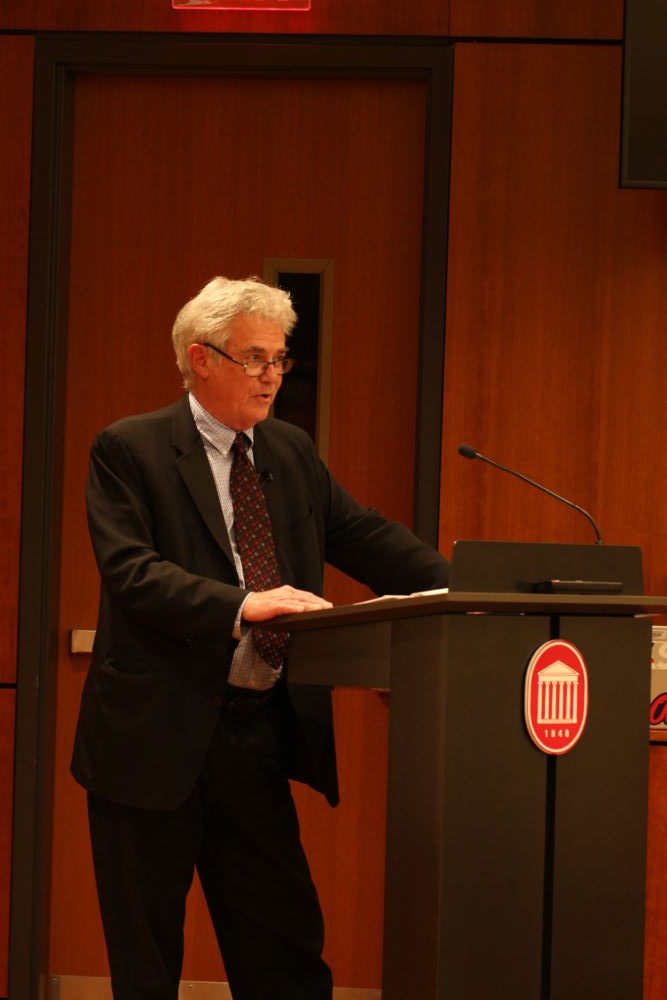
AlfonsiOle Miss journalism and integrated marketing communications students and their families packed the Ford Center on Saturday, May 11.  Doing the honors as the keynote speaker was Sharyn Alfonsi, a 1994 journalism graduate from Ole Miss.  Alfonsi is now a correspondent for CBS’ “60 Minutes Sports,” which airs on Showtime.

Alfonsi’s speech delighted the crowd and offered advice on how to succeed with both life and making a living.

The following is a transcript of the speech; a video version is also included:

Dean Norton, parents, faculty and friends and graduates.  Good afternoon and congratulations. To be clear,  I know exactly why I was given the amazing opportunity to speak to you on such an important day.

It is not because of any impressive journalism awards; it’s not because you want to hear stories from war zones;  it is not even because of my terrific head of hair on an oppressively humid day.  I know the one and only reason I am here is because Shepard Smith was clearly not available.

Still, let me thank you for this tremendous honor. I graduated from Ole Miss with a degree in journalism, roughly 104 years ago today.

There was no journalism school at that time. It wasn’t a popular choice.

It was believed that the smart students went to the School of Pharmacy because clearly it takes a genius to count pills and hand out ointment for angry looking rashes.  Those who were especially talented pursued fine arts degrees because you need to spend  tens of thousands  on college before you can pursue your dream to make pottery.  And then there were the kids from the School of Engineering.   I actually didn’t ever hang out with anyone from that school, but neither did anyone else; you get the idea.

Still,  it was believed that journalism students were the misfits — the odd ones.  Looking at you all today,  and at this gorgeous new journalism school, I am delighted to see, nothing has changed.

It looks a little like Scooby Doo’s Mystery Van got lost and you all popped out the back.

I see the Velmas, sporting glasses or comfortable shoes,  with dreams of working at NPR or the Economist.

The  Freds, who hope their good looks and smart ascots might lead to a seat at the anchor desk at the local TV station.

And of course the Shaggys, those who spent a little too much time in the smoke-filled booth at “Rebel Radio,”  emerging only for “Scooby Snacks.”

Parents, if you fear your child is a Shaggy — and a tip off is they may be wearing flip flops or TEVAs today with their caps and gowns — don’t worry.    The good news is you will be seeing a lot of them.   They’ll be living in your basement for the next 10 years, emerging every time they have a problem with the Wi-Fi.

But I am here to deliver good news to you all today.   As you all know the economy is pumping,  high paying journalism jobs are everywhere and as a person who has lived in New York City for the last decade, I am delighted to report that the “Media Elite” have absolutely no preconceived notions about people from Mississippi.

And that story about the Elvis impersonator, who may or may not have been set up by a karate instructor, who may or may not have tried to poison the president, really helped things.

I am here to tell you everything I know.  So this should take roughly  23 seconds.

When I was applying for jobs my senior year, I sent my resume tape to two dozen television stations.   Most of them did not call or write back, but one news director did write back.   Here’s what he wrote — this is an excerpt from the actual letter:

Dear Ms. Alfonsi,

Thank you for your application for the news reporter position.  Unfortunately,  we have hired a qualified applicant.  (The word qualified was underlined).

I know you are beginning your career, so please allow me to give you a bit of feedback.

Your reporting skills show some promise however, you need a lot of work.   Your hair is too big, your accent too thick and overall, you look a little equine on camera. 

Now for those of you who didn’t catch that, he just called me equine.   He said I looked like a horse.  A horse.

He went on.

Best of luck with your career in television; I look forward to seeing more of your work.

And then he signed his name, which side note: looks like the writing of a serial killer.

Now, a normal person would have finished a bottle of Maker’s Mark and started filling out applications at the racetrack, but I was actually encouraged by this letter.  He said he wanted to see more of my work.

This leads me to my first piece of advice:  Do not take NO for an answer.

Not when you’re applying for jobs; not when you actually get a job.

People will tell you,  “No, were not hiring.”  “No,  I don’t want to do an interview with you.”  “No, you may not sleep on my porch and use my cat as a pillow until I change my mind.”

Keep pressing.  You are applying for work in journalism, not trying to get hired as a social secretary.  The people who may hire you respect grit.  They respect tenacity, and in my experience,  I have found they are generally unlikely to issue a restraining order.

If you, like me, were raised by a beautiful, genteel mother with exceedingly good manners, being pushy will make you wildly uncomfortable, but keep at it.     Prove that you want it.

The food court at the mall is littered with journalism students who didn’t fight for it.   Fight for it.

And if you somehow get an offer to do any job, no matter how small or insignificant in the field you want to work in, take it.     There is no job too small.

Yes, it is true, if you do the math (or since you’re a journalism graduate, if you have your roommate do the math) you would likely make more working at a Cracker Barrel than in your first job in journalism.

And if you worked at Cracker Barrel you get to eat your weight in delicious fried apples and get discounts on sock monkeys, but take the journalism job.   It will pay off, eventually.

You will never work harder;  you will never have more fun.  It will not be easy.  You will want to quit.   I’ve wanted to quit a dozen times over the last decade.

Really?  I  have to come in at 2 am and turn a story for Good Morning America because Lindsay Lohan forgot her underpants…. again?

Really?!  I’m eight months pregnant and there’s no one else at this entire network you can send to cover the hurricane?”

“Seriously,  After I spent  five hours in the driving rain covering the hurricane, you’re going to complain about my hair?!  Really?”

For every one of those crappy  days,  you’ll have ten great ones.

“Really, I’m going to the White House today?”

“Really,  I’m going to spend the day watching the Yale Crew team workout? And  I am getting paid for this? Fantastic!”

And while those great days may make you feel great, on top of the world almost,  you might even think,  “Hey, I’ve made it!”  and relax a little and  get comfortable.   Here’s my next piece of advice.

Don’t  get comfortable.   Ever.

I  recently got a job at  “60 Minutes Sports.”   The show is entirely produced and presented by the “60 Minutes” team you’re used to seeing every Sunday nigh, but it appears on Showtime so technically we could cuss.   I won’t.  But we could.   It is the job I always dreamed of.

Actually,  when I was little I dreamed of being Mrs. George Michael, but it became pretty clear when he married a man that wasn’t  a great option.   So, I set my sights on CBS, specifically “60 Minutes.”

I wanted to be a great reporter — not an anchor, a reporter.  In my mind,  Mike Wallace’s blistering interviews were art.    No one was cooler than Ed Bradley.    But I set my sights on “60 Minutes” after watching a young Meredith Viera go head to head with casino magnate Steve Wynn.  I can’t remember what she asked him, but he ripped off his mic and at one point threatened to strangle her.  It was delicious.  I knew in that moment, i wanted to do that — not get strangled,  the other part.

Working my way up the ladder in local news, news directors,  displaying bouts of seriously impaired judgment, offered me jobs to anchor the news.

For those of you who don’t know,  anchoring  in a local market generally  means you get more money, have some editorial control and best of all you’d get your face on the side of a bus or a billboard right  next to an advertisement for  check cashing or a gentleman’s club.   In a word,  prestige.

It would be a more comfortable life, I was sure.    But I had my eye on being a reporter and knew that anchoring would take me off the streets.  So, to the bewilderment of my bosses,  I passed the jobs up.

If you’re not too comfortable,  it’s always easier to leave,  to move on  and hopefully, move up.

So, now that I have my dream job, you’d think I might relax a little, get comfortable.  You’d be wrong.   See the thing is when you have your dream job, especially when people like Scott Pelley,  Leslie Stahl and  Morley Safer work down the hall,  you’re pretty sure you’re the admissions’ mistake.

I am fairly confident that I am.  This isn’t false modesty; it’s a fact.   I am not the smartest person who ever worked in a newsroom.  I don’t have an Ivy League pedigree or an exotic  accent that makes me sound worldly, but I am scrappy as hell, and in Journalism,  scrappy counts.

So dream big,  but work hard and believe me when I tell you this…there are no shortcuts.

I used to work for ABC News.    Disney owns ABC News,  in case you didn’t know.  When I arrived there they called me a quote, “cast member,” and  told me that I got special perks at the theme parks.

One of my colleagues later informed me that at Disney,  you can pay extra money to get  a pass that allows you,  essentially, to  get to the front of the lines for rides.

I found this appalling and then immediately asked,  “Where do I get one?”

But it turns out,  the thing is,  if you cut to the front of line,  you just don’t enjoy the ride as much.  Really.  You need to sweat with the masses.  You need to watch the weaker,  or perhaps wiser,  people who can’t handle it, quit.  It’s fun to make friends with people along the way.   Not the guy wearing an “I’m with Goofy” t-shirt and  bedazzled denim short, but the other people.

Along the way you will meet people you will never forget, characters like no other.  I can’t remember half the stories I did, but I remember just about every fantastic photographer or producer along the way.

They acted as my teachers,  my psychiatrists and often, my parole officers.  They still do.

One of my favorites, Danny Marotta, a veteran photographer from South Boston.  He fought in Vietnam and reminded me  whenever I got stressed,  “It’s just TV, pal; it’s just TV.”

Don’t take yourself too seriously.    No one else will.     You work in journalism.     You’re not performing heart surgery.

On a good day, you will tell somebody something they don’t know.  I have taxi drivers who do that regularly and they don’t get awards for it.

On a great day,  you’ll dig deeper, tell a story so well it gets attention,  changes  lives, policy or conversation.  Those days, I’m not going to lie, are golden.    Strive for them.

And  if you don’t know exactly how to do that right now,  don’t’ sweat it.

You have made your way through what I believe is honestly the of the best journalism schools in the county.  Still, most of the important lessons about journalism you have yet to learn.    Your professors are passing you on to a new set of teachers:    Newspaper editors with nicotine patches,  guys carrying a camera in one hand, and a Dunkin Donuts coffee in the other and office secretaries who know more than you’ll ever forget.

So listen to them,  be humble and  be nice to everyone.  It is great to have an important or interesting job  but I am telling you that in the long run, it is more important than almost anything  you do to be nice.

Now,  since we are  in the South,  and most people are already nice, I feel I should clarify.  Don’t confuse “nice” with what I call “stupid nice.”

“Nice” is carrying a tripod for a photographer whose already loaded down with equipment.

“Stupid nice’ is saying to him,  “Don’t worry you don’t need to carry a light kit too, I’m a natural beauty.”

“Nice” is congratulating a colleague when they did a good job.

“Stupid nice” is later saying to that same colleague,  “You did such a good  job; why don’t you just go ahead and  do this  interview with the president instead of me?”

Don’t be stupid nice.  Be nice. There will be days when this will take everything you’ve got.

I have met some honestly horrific people along the way,  awful, wretched individuals and right now I would like to take the opportunity to name each one of them.

Publicly.

(No one’s recording this, right?)

There was one senior producer  I worked for who was so nasty she went out of her way to try and make me miserable.   Often,  she succeeded.    She made me want to quit.

Then,  I remember something my father used to tell me before every track meet.

Well first,  he’d say,  “Make sure you tie your laces,  Einstein.”  Then, he’d say. “Ignore the competition and just run your race.’

Throughout your career people will try to distract you.  Some will scream at you,  others will say things behind your back,  and a few feral animals will  literally try to throw their stiletto heel in in your lane and trip you.    Keep your eyes straight ahead and just run your race.

Don’t worry what others are doing; they are nothing more than a distraction.  Drown out the critics.  Don’t engage in office politics or gossip.  Don’t worry about the guy next you.  Run your race.

Now, I am the first to admit I am a cautionary tale here.

I was running so hard,  working so much, I looked up one day and realized,  suddenly,  “Oh crap, I forgot to have kids!”    It was literally like that.  I was opening Christmas cards from friend and suddenly their babies were  teenagers.

The good news? I was married and had been for 15 years to a man who is a saint, and fortunately, we  keep the house stocked with wine, so we quickly remedied the situation.  I now have two toddlers.

But I am 40 years old and have two toddlers! I am exhausted.

So, can you have it all?   Yes, yes you can.   But can you have it all at once?   Not so much.

Sometimes it will be all about your career,  other times more about your family or your kids.   Expect it to shift, expect  it to change.   And  that is okay.   That is life.

Your life will  have chapters, complete with crazy characters, villains and a  plot you can’t even imagine as you sit here today.

It’s a lot like a Scooby Doo episode.

You’re gonna see things you can’t believe.  Surround yourself with good friends.    Keep your eyes on the road ahead.   The  haunted mansion is a not a great short cut.  Ask questions.  Be scrappy.  Break up the plots of villains.  And  don’t worry about Scooby Snacks, you’re an Ole Miss grad, grab a bourbon and enjoy the ride.

Thank you all,  kiss your parents, hug your mothers,  good luck  and congratulations.

On Being a Reporter, by Tommy Miller

By Paige Williams

Tommy Miller

Tommy Miller

Still cleaning out files, and just came across this, from college, when I started writing newspaper stories for Tommy Miller and under the deanship of Will Norton and in the great big shadow of the incomparable Neely Tucker. Miller was an old UPI hand and a Houston Chronicle deputy managing editor, and we revered and adored him. He gave us many things, this among them:

On Being A Reporter

In order to be a reporter you must be more than a writer. You learn to adopt the personality of the reporter. Your whole approach to everything must be to portray the picture you hope to portray. The primary factors? Objectivity, seriousness, thoroughness, compassion, interest, accuracy, accuracy, accuracy.

Traits and characteristics you never thought important now are, especially if you’re covering a beat. You must wear well. You cannot afford to irritate. You must learn how to size people up and react accordingly. At the same time, you must adopt a code that is strong, professional, unswerving.

You will be evaluated by two factors: the impression you leave and the impression your stories leave.

Nothing will turn off a contact quicker than ignorance, unless it is uninterest (not disinterest). I emphasize that as a reporter you ought to be interested in everything. Everything. You should never even consider that there are things in this world that don’t interest you.

More important, you have to accumulate facts, figures, situations, etc., that allow you to be expressive in several fields — and that allow you to ask questions and understand answers on the level of the people who are making news.

The point is attentiveness. You should begin to assimilate information daily, all the time, until you can make the gaining of such information a part of your normal existence. Then you’ll begin to think in terms of news — what’s important, what’s worthwhile, what’s incidental, what’s interesting, what it takes to become a reporter.

This involves reading, reading, reading, listening, listening, listening, watching, watching, watching.

Develop a code of honor:

1. Be completely honest. Make this a reflex action. Don’t ever consider that you should shade or cloud things. You’ll get yourself entangled if you do. You’ll have a clean conscience and a good reputation if you don’t. Admit when you’re wrong and move on.

2. Be frank with everyone, especially yourself. Don’t be constantly apologetic. At the same time, don’t regard yourself too highly. Find the medium. Understand your strengths and limitations.

3. Adopt a high ethical standard of fairness, objectivity, and compassion in your reporting and writing. Don’t do anything for anybody. Don’t adopt a state of mind that is anti-anybody. Don’t reveal your personal feelings and attitudes about issues — in the field and especially in your work.

Meek School salutes 2012-13 student media leaders


Emily Roland, Editor-in-Chief, The Daily Mississippian 

By Casey Holliday

Roland Photo

Photo by Thomas Graning

As Emily Roland walked across the stage of the Ford Center for the Performing Arts to be awarded a place in the Hall of Fame, a laundry list of achievements were rattled off: editor-in-chief of The Daily Mississippian, president of the Society of Professional Journalists chapter, choir member, recipient of the Community Foundation of Greater Jackson Scholarship.

From a young age, Roland, a senior print journalism major, was interested in music and travel. Her dad, a musician, told Emily to avoid the field and instead combine those passions with her interest in English and writing and become a journalist.

“I had never thought about working for a newspaper until my dad suggested it,” Roland said. “It just kind of stuck. The more I got into it, the idea of journalism really attracted me.”

Roland walked into the Student Media Center on the third day of her freshman year to ask to be a writer for The Daily Mississippian. It was then that she would meet Alex McDaniel, the editor-in-chief at the time.

Sitting behind McDaniel at the editing desk almost every day, Roland would question every change and edit to improve her own writing and lay the groundwork for what was to come. (Read more)


Elizabeth Beaver, Editor-in-Chief, The Ole Miss 

By Jane Lloyd Brown

Photo by Mikki Harris

Photo by Mikki Harris

With The Ole Miss yearbook heading to print and final touches completed, one would expect Editor-in-Chief Elizabeth Beaver to enjoy a break from the Student Media Center’s hectic buzz.

Instead Beaver, a senior journalism major and art minor, hustles around the center giving direction on design projects and offering advice to student writers.

The editors on Beaver’s staff include Miriam Taylor, design editor; Alex Edwards, photo editor; Jake Thompson, sports editor; and Callie Daniels, writing editor.

“It’s madness all the time,” Beaver said of working with her team in the SMC. “We’re like a big rolling circus.”

The yearbook process naturally works at a slower pace than the other media components because the staff do not have daily deadlines.

This year, the staff wanted to get the book done early so that they would have time to fix any mistakes before the publication went to print.

With Beaver also juggling schoolwork with a barista job at High Point Coffee and getting engaged this year, finishing the yearbook before deadline was difficult. (Read more)


Stewart Pirani, Manager, NewsWatch

By Kayleigh Webb

Photo by Mikki Harris

Photo by Mikki Harris

It’s 3:30pm on a Wednesday afternoon, and sitting confidently in the control room of the Student Media Center behind a computer editing video is Stewart Pirani. Pirani, an Ole Miss junior pursing a degree in broadcast journalism and a minor in cinema studies, is the  manager for NewsWatch, a live, student-run news program that airs on channel 99 at 5 p.m. on weekdays.

His love of television and producing started earlier. It began in high school, where Pirani took a class in television production. The class emphasized producing a live news program.

“I got there on the first day and I walked into the studio and the control room,” Pirani said. “I saw everything: the technology, the lights, the buttons, the monitors. I just knew that what I wanted to do for the rest of my life was television.”

After four years of the class, Pirani had his sights set on Ole Miss because of the broadcast journalism program.

Pirani began working in the Student Media Center at Ole Miss during his freshman year. His first projects were with Chatterbox, a comedy show that was produced in the media center studio.

“It helped me step my foot into NewsWatch,” Pirani said. “I started doing it that second semester my freshman year and I’ve not left since.” (Read more)


Lindsey Malley, Manager, Rebel Radio

By Mary Ashton Nall

Photo by Thomas Graning

Photo by Thomas Graning

Lindsey Malley answers each question her staff asks with kindness and expertise as she looks up from making adjustments to her calendar.  Malley, an Ole Miss senior from Long Beach, Miss, is the manager of Rebel Radio — possibly the only student-run, commercially licensed  radio station in the nation.

The station provides an array of popular music and news updates for the Oxford area.  Rebel Radio also invites bands, Ole Miss ASB officers, administration, and athletic coaches and players on air weekly to talk about ongoing campus and community activities.

The station is open to the entire student body for auditions. Malley tried out for a position as a DJ her sophomore year. As a pharmacy major, she believes the station is an opportunity for every student, not just journalism majors. She encourages more students to become involved.

“Rebel Radio is a creative outlet for anyone with a strong personality,” Malley said. “If you have that, we want you here.” (Read more)


Journalism grad Bill Miles’ papers donated

Bill Miles, left, was joined by Dr. David Cole and former Rep. Billy McCoy, right, at a ceremony presenting Miles’ political files to the Ole Miss library. Miles has had a career in reporting news, publishing, political consulting and serving in the Mississippi Legislature. Cole is president of Itawamba Community College and McCoy served as speaker of the Mississippi House during Miles’ terms in office.

Bill Miles, left, was joined by Dr. David Cole and former Rep. Billy McCoy, right, at a ceremony presenting Miles’ political files to the Ole Miss library. Miles has had a career in reporting news, publishing, political consulting and serving in the Mississippi Legislature. Cole is president of Itawamba Community College and McCoy served as speaker of the Mississippi House during Miles’ terms in office.

Bill Miles, an early Journalism graduate who went on to a career in reporting, publishing, consulting and two terms in the Mississippi Legislature, has donated his political papers to the J.D. Williams Library at the University of Mississippi.

The gift was made official in an April 29 ceremony, featuring former House Speaker Billy McCoy of Rienzi and Rep. Steve Holland of Plantersville as keynote speakers.

Dr. Ed Meek, for whom the Meek School is named, commented that Miles was ahead of him in classes. “Just watch Bill Miles and do what he does,” Meek quoted early professor and chairman Sam Talbert as saying. “I did, and I have been doing it since,” Meek said.

The event also showcased several vintage campaign commercials produced by the Bill Miles Associates firm for north Mississippi candidates.“We’re also opening the Bill Miles Collection to researchers,” said Leigh McWhite, political papers archivist and associate professor at UM. “Among the current holdings of the Modern Political Archives, the Miles Collection is quite unique.”

Contained within the collection are documents, photographs and recordings on the campaigns of several north Mississippi candidates as well as Miles’s own files from his 12 years in the Legislature. The collection also includes diaries that he kept while it was in session.

“I feel very humbled to be included in an illustrious group of individuals whose accomplishments have impacted Mississippi’s history,” Miles said. “By the luck of the draw, I was fortunate, in most instances, to be an observer and, sometimes, a participant in some unusual events.”

While Miles had considered the possibility of Ole Miss being the custodian of anything worthwhile for future researchers, it was not until he was contacted by key players in the 50th anniversary observance of James Meredith’s enrollment that he made a commitment.

“Dr. Ed Meek and Dr. Andy Mullins pressed me hard by flattering me that my stuff might be worthwhile,” Miles said. “Ole Miss has meant a lot in my own education, and for my children and grandchildren. When I was shown the extent of the archives – where it is housed and its documentation – I was very impressed. And the university is a place where scholars can use ordinary collections, such as mine, for extraordinary benefits for the future.”

After working briefly as a journalist, Miles formed the advertising/public relations firm Bristow-Miles Associates Inc. in 1963 in Tupelo. After later becoming Bill Miles Associates, the firm often represented local political candidates. In 1996, voters of Itawamba and Monroe counties sent Miles to the Mississippi House of Representatives, where he remained for 12 years.

“The most meaningful period in my career probably was during my legislative service, where my friendship and relationship with Speaker Billy McCoy resulted in my appointment as chairman of transportation and as a key adviser to him during very turbulent times,” Miles said. “I certainly enjoyed the association I had with the late Congressman Jamie Whitten, as he attained his high rank in the U.S. Congress. As one back home in his First Congressional District on whom he might rely for counsel, I had the unusual perch on which I observed and sometimes helped him get programs and projects which benefited Mississippians.”

For more information about the Bill Miles Collection at the University of Mississippi, visit http://clio.lib.olemiss.edu/cdm/landingpage/collection/miles/.


Meek School students win national journalism honors

MAMThe Society of Professional Journalists Mark of Excellence Awards competition receives more than 4,500 entries each year from hundreds of journalism programs around the country.

This year, broadcast journalism students Margaret Ann Morgan and Stephen Quinn have been awarded first place honors for their breaking news television coverage of Hurricane Isaac. Their stories aired on the student-produced newscast NewsWatch 99 and were part of a multimedia coverage effort surrounding this major storm on the Mississippi coastline.

In addition, The Flood of the Century magazine was one of two national finalists in the best student magazine category, and student Jared Burleson was a national finalist for his feature photography.

SPJ Is the country’s largest and oldest professional journalism organization in the country.  The winners will be honored at the national convention in Anaheim, Calif. on August 25.

Mobile newsroom created for coverage of Double Decker Festival

Journalism students take over High Point Coffee couches as a makeshift newsroom at the Double Decker Festival.  Photo by Deb Wenger.  April 27, 2013.

Journalism students take over High Point Coffee couches as a makeshift newsroom at the Double Decker Festival. Photo by Deb Wenger. April 27, 2013.

Five broadcast journalism students put their multimedia skills to the test during Oxford’s 18th Annual Double Decker Festival.  Under the direction of professors Nancy Dupont and Deb Wenger, the team went to work for both WTVA-TV in Tupelo and HottyToddy.com in Oxford, covering events that began as early as 7:30 a.m. and working well past the end of the 6 p.m. newscast on WTVA.

The students also felt the pressure of real-time reporting with additional requirements to tweet story updates and photos, as well as to write text pieces for the Hotty Toddy website.

This is the second year in a row that Meek School students have covered the festival for WTVA.  C.J. LeMaster, who anchors and produces the WTVA weekend shows, says the station is happy to work with the students and he enjoys helping them get the experience they’ll need to succeed on the job.

“It’s a humbling experience for me. Not that long ago, I was in their shoes, trying to learn as much as I could. No matter how young or ‘green’ you are as a journalist, you have to start somewhere, and someone has to give you that break, that chance to prove yourself,” said LeMaster. “It’s an honor and a privilege to help these students get some real feedback and experience in the industry.”

Graduating senior Stephen Quinn woke up before the sun to cover the Double Decker Spring Run.  He found dozens of participants dedicating their miles to the victims of the Boston Marathon bombing.

Students Brittani Acuff and Stewart Pirani focused one story on festival food for the HottyToddy website and another on a Tupelo artist for the WTVA Sunday newscast.

Brandon Rook found out why so many people come back to Double Decker year after year for his piece which aired on WTVA’s 10 p.m. show on Saturday night.

But it may have been Bracey Harris who had the most fun covering the Square Fair for Kids where the younger set had a blast with the space-themed amusements.

Harris appreciated the chance to learn about working under deadline pressure.

“Today gave me experience that can only be gained outside of the classroom. I am fortunate to have guidance from Meek School faculty even when the week ends,” said Harris. “I found myself challenged and even frustrated at times, but the lesson was worth it. Field work is organized chaos, but I survived and am better prepared for the future because of it.”

Mission Ole Miss: Journalists and ROTC team up for learning

Embedded journalists cover the ROTC final field exercise.  Photo by Maggie McDaniel.  April 25, 2013.

Embedded journalists cover the ROTC final field exercise. Photo by Maggie McDaniel. April 25, 2013.

It took four platoons of ROTC cadets, about a dozen Arabic-speaking students and a team of ten Meek School reporters to pull off Operation Rebel Charge on April 25.  Ole Miss ROTC took over the Whirlpool Trails on the edge of campus in their final field exercise of the year.

Four students from Prof. Deb Wenger’s advanced TV reporting class embedded with the platoons and learned something about what it’s like to rely on the very people you’re covering, not only for information, but for safety.

“I think the journalism students also got an entirely new perspective on how much preparation it takes to effectively cover stories about war and issues of national security,” said Wenger. “Students got a crash course in how essential research is when it comes to conducting good interviews.”

For their part, the cadets learned how to handle tough questions from the media — getting practice in how to share information without over-stepping their bounds as representatives of the military and without giving away details that would put troops at risk.

The ROTC’s Lt. Col. Nate Minami spearheaded the effort to bring in, not only journalism students, but also student studying Arabic at Ole Miss.  The Arabic language students played the role of villagers with whom the cadets had to work to secure an area within the fictional land of Atropia.  The cadets learned how to work through an interpreter and the Arabic students got to practice both their speaking and translation skills.

The exercise was made as real as possible, featuring mock explosive devices, enemy combatants and a race against time.  Journalism students also got a chance to explore some of the issues facing today’s military, such as the move to allow women to take part in combat someday soon.

Even some of the first-year journalism students got a chance to get involved.  Students in Wenger’s multimedia writing course took part in the news conference that wrapped up the exercise.

“It was actually kind of fun,” said Katie Lovett.

NewsWatch tops in Mississippi student newscasts

NewsWatch with awards

Pictured L-R; Stephen Quinn, Margaret Ann Morgan, John Monteith, and Gerard Manogin. Photo by Nancy Dupont, April 20, 2013.

For the second year in a row, NewsWatch won first place in Student TV Newscasts at the Mississippi Associated Press Broadcasters (MAPB) banquet held Saturday, April 20 in Jackson.

Stephen Quinn won second place in TV News Reporting for his story on the 50th anniversary of integration at Ole Miss.  Norman Seawright won third place in Student TV Documentaries for his series on Togo.

NewsWatch also took home third place in Student TV Weathercasting.

For the past year, Nancy Dupont has been serving as the President of MAPB.  She will continue to serve as a board member during 2013-14.


Newseum opens JFK exhibits with artifacts never publicly displayed

Kennedy PhotoThe Newseum, a museum devoted to journalism and the First Amendment, recently opened two exhibits on President John F. Kennedy leading up to the 50th anniversary of his death. The artifacts include restored photographs, Abraham Zapruder’s camera, and the shirt worn by Lee Harvey Oswald on the day he was arrested. View coverage of the exhibits at cbsnews.com, msnbc.com, and nytimes.com. The Newseum is located in Washington, D.C.

Forbes chief products officer discusses state of the media business

Lewis DVorkin

Lewis DVorkin

Lewis DVorkin, chief products officer for Forbes, recently joined Adam Penenberg of PandoDaily to talk about the state of the media business. Watch the interview at pandodaily.com.

Meek students receive APME awards

Jared Senseman, Emily Roland, Phil McCausland, and Pat Thompson, director of Student Media

Jared Senseman, Emily Roland, Phil McCausland, and Pat Thompson, director of Student Media

University of Mississippi students won six awards in the Mississippi/Louisiana Associated Press Managing Editors contest for work published in 2012. The awards luncheon was held April 13 at the Overby Center.

Daily Mississippian Opinion Editor Phil McCausland won first place for his editorial about election night events, headlined “We Cannot Disregard Our History and Our Responsibility.”

Jared Senseman won first place in the College Bureau/Features category, for an article about the university medical marijuana lab published in the Clarion Ledger and USA Today.

Emily Roland and Sealy Smith

Emily Roland and Sealy Smith

The Daily Mississippian won second place for General Excellence. Sealy Smith won second place for features for an article in the DM headlined ” ‘Hitt’ too hard: Corporal punishment in public schools.” DM Editor in Chief Emily Roland won third place for layout and design, for her design of three DM front pages. Cain Madden won third place in College Bureau/Features for an article about the revitalization of downtown Hattiesburg published in the Hattiesburg American from one of the Meek School-sponsored weekend reporting trips.

Several recent graduates and former DM staffers, now working at newspapers in Mississippi and Louisiana, also won awards. They included Sheena Baker, Daily Times Leader; Alex McDaniel, Clarion Ledger; J.B. Clark, Daily Journal; and Ryan Moore, Hattiesburg American.


Multimedia storytelling guru speaks at Meek School

Brian Storm breaks down a multimedia piece during his presentation at the University of Mississippi. Photo by Alex Edwards.

Brian Storm breaks down a multimedia piece during his presentation at the University of Mississippi. Photo by Alex Edwards.

By Lauren Loyless

MediaStorm founder Brian Storm spoke to journalism students and the community of Oxford, Miss. about multimedia and the art of storytelling at the Ole Miss Overby Center April 5.. It was not long before the audience learned that Storm is funny, clever and edgy when discussing journalism.

“You are either in this game for the right reason or you’re a poser and need to get out,” said Storm. “We all know each other, business is small and someone in this room will probably hire you.”

Not only is he the founder of the widely recognized MediaStorm company, but he also has the passion and drive to produce what he calls old school journalism in a technology-driven world. Storm believes in focusing on quality, claiming it’s not about the medium that the story is presented on, but instead the good storytelling that gives a voice to the people.

“An iPad is not going to save journalism,” said Storm. “Great stories will save journalism. If you’re going to be a journalist … it’s not about you. It’s about the people whose stories you’re telling.”

MediaStorm is celebrated worldwide because of its ability to give a voice to the common man and tell the story that is not exactly easy to hear. Storm emphasizes doing a few things really well, and with a staff of nine. the company manages the production of a few multimedia stories a year. The stories range in coverage of the Tutsis’ genocide in “Intended Consequences,” to telling the story of a young man who loses his father in “A Shadow Remains.” What makes these stories so relatable to others is that they are raw with emotion and real. After Storm showed the trailers during his presentation, journalism students were left inspired to produce the same type of top-notch multimedia.

“Heartbreaking but eye-opening, you should watch “Intended Consequences” and see the results of this genocide in Rwanda,” said Ole Miss student Alessandra Richards. “Also watch the preview to “A Shadow Remains.” It’s so captivating and you will want to watch more!”

“Multimedia in the classroom is not talked about in depth the way he talked about it here tonight. It really opened my eyes,” said Ole Miss student Jessica Day.

Bloggers like the Director of National Geographic and popular news websites such as MSNBC and Reuters have promoted MediaStorm’s productions. Storm also works for some NGO and nonprofit clients that he says desperately need storytellers and journalists. However, his company cannot tell every story and typically turn down 70 percent of clients.

“There is no secret about what we are doing, we want everyone to know so they can form companies like us. Start your own company and tell your own stories,” said Storm.

For more about this story, search Storify and Twitter for #StormOM.

UM students recognized for excellence in journalism

SPJ 2013 Awardees

Photo by Katie Williamson

University of Mississippi students won 19 awards in the Society of Professional Journalists Region 12 annual Mark of Excellence contest.

The awards included 11 first places, 6 second places, and 2 third places. Region 12 includes all colleges in Mississipppi, Louisiana, Arkansas and Tennessee.

All first-place winners will now compete against first-place winners in the other 11 regions for the national SPJ Mark of Excellence Awards.

The staff of “The Flood of the Century” won first place for Best Student Magazine. The Daily Mississippian won second place for Best All-Around Daily Newspaper, NewsWatch won second place for Best All-Around Television Newscast, and theDMonline.com won second place for Best Affiliated Website.

In the individual categories, the following students won first-place awards:

  • Austin McAfee for Breaking News Photography, for his photograph of the Dierks Bentley concert published in The Daily Mississippian
  • Thomas Graning for Sports Photography, for “Streak Snapped,” a DM photograph of the Rebels football team
  • Josh Clark for a series of editorial cartoons in the DM
  • Jared Burleson for Feature Photography for his work in “The Flood of the Century”
  • Jajuan McNeil for General News Photography for “The Road to Belize,” a photograph from “M-Powered,” about an empowerment project in Belize;
  • Jennifer Nassar for General News Reporting for “What is World Religion” in the DM;
  • Nick Andrews for Radio Reporting, for a segment about election night
  • Margaret Ann Morgan and Stephen Quinn for TV Breaking News for “Live from Biloxi: Tracking Isaac”
  • Norman Seawright for TV in-depth, for “Engineers Aid Village in Togo”
  • Betsy Lynch and Ashley Lance for TV Feature, for “Locally Produced Foods Important to Lafayette County, Mississippi”

Students who won second-place awards were:

  • Austin McAfee for Sports Photography for coverage of a track meet
  • Adam Ganucheau for Sports Writing for “50 Years Undefeated”
  • Aubry Killion and Margaret Ann Morgan for TV General News Reporting for “The Road to Belize”

Third-place awards were given to Austin Miller for Sports Writing for “Nkemdiche Making a Name for Himself,” and to Tim Abram for General Column Writing for a series of columns on the DM opinion pages.

Eighteen universities in the four states won awards in this year’s Region 12 contest.

Broadcast profs lead packed training sessions at national conference

Associate professor Nancy Dupont leads session crafting the best resume reel.

Associate professor Nancy Dupont leads session crafting the best resume reel.

Meek School professors Deb Wenger and Nancy Dupont shared ideas with journalism colleagues and students April 8-10 at the Broadcast Education Association national convention in Las Vegas.

Professor Wenger led a session on mobile newsgathering and was a panelist in a session on recruiting and retaining students.  She outlined the success of Meek’s Summer Producer Program in a session on building TV news internships.  The producer program is Wenger’s brainchild and has already resulted in full-time jobs for Meek graduates.

Professor Dupont led a session with TV news directors from around the country on how students can win the job with an effective resume video.  The standing room only crowd was testament to the need for and the impact of the session.  Dupont also served as the vice-chair for research for BEA’s News Division.

BEA is an organization of over 1,000 professors, media professionals and students dedicated to teaching and research of the multimedia and broadcasting industries.  The Meek School is an institutional member of BEA.

DOD task force director to speak at final Stuart Bullion Memorial Lecture on April 15

James Bullion

James L. Bullion

The final Stuart Bullion Memorial Lecture will be held on Monday, April 15, at 8 a.m. in the Farley Hall auditorium. James L. Bullion, Stuart Bullion’s brother, will be the guest lecturer. The family has opted to convert the lecture fund to a scholarship fund that will assist an Honors College student majoring in journalism.

Bullion, who works for the Department of Defense, will provide an update on media projects both in Afghanistan and Iraq where he has been working.

Bullion was sworn in as the Director of the Task Force for Business Stability Operations (TFBSO) in 2012. In this role, he is responsible for helping to stimulate the private sector of the Afghan economy by enabling direct foreign investment, supporting business creation and growth, and promoting entrepreneurship.

Prior to joining TFBSO, Bullion was president of Phoenix Global Services, LLC, a strategy and management consulting firm that helps companies design and implement new strategies, restructure operations and develop new products and market opportunities. His clients have ranged from private equity companies to technology companies and service providers.

Bullion is a retired colonel of the United States Army Reserve, having received his commission through ROTC at Dartmouth College in 1982. Prior to founding Phoenix Global Services, Bullion served two tours in Iraq with the U.S. Army, as executive officer and commander of a Civil Affairs battalion in Northern Iraq, and then as Chief of Plans and Operations (J3) for the Multinational Security Transition Command – Iraq.

Prior to being mobilized for service in Iraq, Bullion was vice president at Genuity Corporation, a $1 billion Internet backbone provider and telecommunications services company, where he launched a series of new products and managed strategic partnerships. Prior to Genuity, he managed international operations at UNIFI Communications, an early-stage data communications company where he established and oversaw new ventures throughout Asia. Bullion began his career in commercial banking and in investment management. He is a member of the advisory boards of KWantera, an early-stage energy management services company, and of Zero Point Risk Management, a risk mitigation advisory firm. He is also a Chartered Financial Analyst.

Bullion earned a B.A. in Economics from Dartmouth College and an MBA from the Amos Tuck School of Business Administration.

Top students hear from top writer

Writer Berkeley Hudson engages student Wanfei Wu at the Kappa Tau Alpha awards luncheon.  Photo by Deb Wenger, April 2, 1013.

Writer Berkeley Hudson engages student Wanfei Wu at the Kappa Tau Alpha awards luncheon. Photo by Deb Wenger, April 2, 1013.

Professor Berkeley Hudson teaches magazine journalism at the Missouri School of Journalism.  The former Los Angles Times writer is also an Ole Miss graduate who recently shared his passion for Mississippi and its stories with students just inducted into Kappa Tau Alpha (KTA).

KTA is a college honor society that recognizes academic excellence and promotes scholarship in journalism and mass communication. Eleven of the newest members received their awards and heard Hudson offer advice on how to have a successful career in telling stories.

  • Read Richard Wright and Willie Morris.  Hudson says you have to know the work of great writers to be great yourself.
  • Get yourself a mentor.  Find someone who will look at your work and help guide your career.  Stay connected to the people you’ve met at Ole Miss.
  • No one can teach you curiosity.  You just have to want to find out why things are the way they are.
  • Your brain is the most important technology.  Though Hudson says he believes in “big tent” journalism — accepting that new forms of communication are valid — he also says that the human brain is the most effective tool we have.

Hudson also asked the group, which was meeting in the Overby Center, to reflect on one of the quotes emblazoned on the wall:

“Long before I wrote stories, I listened for stories.  Listening for them is something more acute than listening to them.”
-Eudora Welty

TVNewsCheck: “Making the Strong Case for Local TV News”

Read WXII president-GM Hank Price’s response to recent criticism of local television news at TVNewsCheck.com.

Remembering “Rat”

Journalism students Katie Williamson and Phillip Waller interviewed and photographed Frank “Rat” Ratliff respectively during a spring break reporting trip to the Delta.

By Susan Puckett

Last week, citizens of Clarksdale and blues travelers from all over were saddened to learn of the passing of Frank Ratliff, longtime proprietor of the Riverside Hotel, where many a bluesman had hung his hat. The loss of this beloved local legend — affectionately known as “Rat” — touched several students and faculty members of the Meek School of Journalism & New Media as well. I was one of them.

I found out about Rat’s death from Phillip Waller, a student in the Delta Project depth reporting class I co-teach with Bill Rose. He posted the news over the weekend on our class’s Facebook page, along with several photos of Rat taken on our spring break field trip to the Delta to research the region’s food traditions and habits for a magazine we are producing. That may very well be the last photographs of Rat ever taken.

Rat is not a cook, and the hotel does not serve food. But I made the case that even if a story on the Riverside Hotel didn’t really fit the food focus of this semester’s magazine, someone should at least pay a visit for some authentic Delta context. After all, Rat was one of the last of his kind, a member of that small fraternity of old-timers who remember the way it was and consider it a moral duty to preserve the old memories (and legends) of this distinct region.

I met Rat for the first time four years ago, soon after I set out to gather material for a food-oriented Delta guidebook, “Eat Drink Delta: A Hungry Traveler’s Journey through the Soul of the South.” My husband, Ralph Ellis, a North Carolinian who had never set foot in Mississippi, joined me for a long weekend that included an overnight stay in Clarksdale. I was a bit taken aback when we spotted this rundown structure in a seedy neighborhood behind a broken Schlitz sign. An elderly black gentleman opened the door and cordially welcomed us in. Immediately he put us at ease.

The Riverside is where famed blues songstress Bessie Smith died, following a car accident while on tour in 1937. At that time, the little brick lodge teetering over the Sunflower River was the G.T. Thomas Hospital, caring for black patients who had nowhere else to go for treatment.

Photo by Phillip Waller

Photo by Phillip Waller

In 1944, when Rat was four years old, his mother, Z.L. “Momma” Hill, took over the building and converted it into a hotel that became a temporary home to a long procession of black musicians. She treated them like her sons, cooking meals for them and sewing their costumes. Rat helped out his whole life, even while employed at the Wonder Bread bakery, and took over the business with his wife Joyce when his mother died. He reserved Room Number 2 as a shrine to Smith, with several portraits of her on the walls and one propped up lovingly on the pillow. Each of the other rooms paid homage to a different musician or other celebrity who had stayed there. Ike Turner. John Lee Hooker. John F. Kennedy, Jr.

Rat gave us the grand tour of each spotless, memorabilia-filled room, as if he were a museum tour guide. We settled on the Pop Staples room, equipped with a disco ball hanging from the ceiling. Before we left to explore the town, Rat invited us into his apartment to help us plan our itinerary, and assured us he would make sure our stay was safe and comfortable. And it was.

Like others who have stayed there, by the time we left we felt like old friends. Ralph snapped my photo with Rat, posed in front of that iconic faded blue and white “Riverside Hotel, Home of the Delta Blues” sign, as a thousand other guests before me.

Right around the time of my book’s release, Meek School Dean Will Norton, one of my journalism professors more than 30 years ago, invited me back to my alma mater to help Bill Rose’s depth reporting class produce a special report on the Delta, as it has for the past three years. The hope was that the research I’d poured into my book could inspire students to delve deeper into more serious issues of economy and health.

In the classes leading up to spring break, Bill and I helped students lay the groundwork for stories on the catfish and prawn industry, obesity, the rise of community gardens, culinary entrepreneurs, and much more. Using the apartments above Ground Zero Blues Club in Clarksdale as our home base, we canvassed the region — talking to people, shooting photos, and eating extremely well.

One of the students in the photography class, Katie Williamson, was intrigued by Rat’s story and tried to set up a photo shoot with help from photography instructor Mikki Harris. They spoke with his daughter, Zelina (“Zee”) Ratliff, whom he had been grooming to take over the business. She said she would ask him, but made no promises. He had been ailing, and was reluctant to give tours to travelers who weren’t staying at the hotel to respect the privacy of the guests. Still, I held out hope.

On the last day of our trip, they finally got word that he would agree to meet them late that afternoon.

When we arrived, Rat was sitting in his usual spot, in a plastic chair on the front porch. He did not stand up to greet us. He seemed exhausted. I wondered if perhaps he wasn’t up to our visit after all and Zee, who was inside, might ask us to leave.

Then Katie took the chair next to him, and deftly switched hats — from photographer to reporter. Phillip Waller pulled out his camera as Katie began chatting with Rat, eventually pulling out her pad and taking some notes of her own.

Photo by Phillip Waller

Photo by Phillip Waller

Slowly Rat began to perk up. In a voice so soft we had to lean in at times to hear him, he began telling us one story after another — some of which I recalled from my earlier visit — while Phillip photographed him. Zee joined into the conversation, as well, and gave us a quick tour of the storied rooms.

As we prepared to leave, I showed him my book, and the passage in which he was quoted. A weak smile appeared on his thin, drawn face. I signed it to him and his daughter. He asked me where my husband was, and said he hoped we’d both come back to stay sometime.

Frank “Rat” Ratliff died at the Riverside on the evening of March 28, 2013, less than two weeks after our visit. For now, the hotel appears in good hands. Like her dad, Zee seems to genuinely relish sharing her family history and Clarksdale heritage with those who care enough to inquire.

Which is a good thing; Rat told the students that there’s so much family history within the hotel he’d rather have it torn down than let anyone other than a blood relative take over.

Whatever the Riverside’s ultimate fate, the stories within it will live on — thanks to journalists who have come to listen — and lean in close, if necessary, to hear the answers.

New speaker endowment honors Mississippi journalist

Bynum PhotoGifts to a new University of Mississippi fund are being used to honor the life of the late James L. “Buddy” Bynum, a leading journalist, and his enthusiasm for communication, learning and the university.

The Buddy Bynum Speaker Series Endowment was established with an initial donation by Dr. Richard B. and Nancy Harrelson Akin of Hazlehurst and is open to contributions from others. “He was my best friend, my mentor, my inspiration and loved Ole Miss better than anything,” Nancy Akin said of the couple’s decision to honor Bynum.

Earnings from the endowment will be used by the university’s Meek School of Journalism and New Media to invite media leaders to meet with students and enhance their learning experiences.

“Buddy had great jobs and a great career; journalism was in his blood,” she said, pointing out that the fund may inspire others.

Bynum was born and reared in Meridian. He started reporting for The Meridian Star after he contacted the community newspaper and told them box scores should be included with their baseball coverage of his school, Nancy Akin said. It became Bynum’s job, she said.

Bynum was Mr. Meridian High School and president of the student body. Then his early interest in journalism continued at Ole Miss where he was summer editor of The Daily Mississippian and was an initiate of Sigma Chi fraternity.

He later returned to Meridian as editor of The Meridian Star newspaper, a title he also held at other publications, including the Mississippi Business Journal and the Oxford Enterprise.

Bynum served as communications director for Gov. Haley Barbour and for former U.S. Sen. Trent Lott when Lott was a member of the U.S. House. While in Washington, he also served as deputy secretary for congressional relations of the Department of Housing and Urban Development and, in March 1988, was named an honorary citizen of New Orleans and presented a key to the city.

After his work for Barbour and the Oxford Enterprise, Bynum chose to enroll at the Meek School in 2009 to complete the few courses needed for his Ole Miss degree.

“Going back to school took amazing courage, but I’ve never seen anyone enjoy anything more,” Nancy Akin said. “The best year of his life may have been back in that academic environment. There wasn’t a class he didn’t like.”

During the summer of 2011, however, Bynum was diagnosed with pancreatic cancer. He died on Sept. 3 at his home in Ridgeland at age 59.

Will Norton Jr., UM journalism dean, said he especially admired Buddy’s determination and cheerful manner in working with and encouraging “classmates” who had little experience in journalism compared to his. The endowment, Norton said, will “in perpetuity enhance the education of students, faculty and the community through visits from media practitioners who, like Buddy, are of the highest quality.”

Donations may be sent to the Buddy Bynum Speaker Series, University of Mississippi Foundation, P.O. Box 249, University, MS 38677-0249. Online gifts can be made here.

Slate: “The Glory Days of American Journalism”

Photo by Mike Groll/AP

Photo by Mike Groll/AP

Read Slate writer Matthew Yglesias’s analysis of the Pew Research Center’s annual “State of the News Media” report.

Husni and Magazine Innovation Center featured in Delta Business Journal

Husni DBJ Cover

Dr. Samir Husni and the Meek School Magazine Innovation Center are spotlighted in the March issue of Delta Business Journal. Read the article.

Journalism grad teams with NFL players and coaches to raise awareness about ALS

Alford and Rodgers

Neil Alford (right) with NFL quarterback Aaron Rodgers.

Neil Alford, a 1996 Meek School graduate, worked with several NFL players and coaches to produce a public service announcement spotlighting ALS that aired during the Super Bowl. Alford, whose company is Neil Alford Productions, produced and directed the spot as part of a campaign to raise awareness about the debilitating brain disease. Read more at The New York Times and USA Today.  Watch the PSA on YouTube.

Student Media on “Spring Break”

Student Media in DC

Part 1: In New York, Talking About Race
“Why Is the Paper Always Talking about Race?” is the title of a presentation by Student Media Director Patricia Thompson, Daily Mississippian Editor in Chief Emily Roland and Opinion Editor Phil McCausland at the College Media Association spring conference in New York. The three were invited by CMA to talk about racially charged issues on campus over the past few years, how the DM and theDMonline manage coverage and deal with the controversies, and the lessons they’ve learned. They answered questions and provided tips for students and advisers.

Emily Roland in Washington Part 2: In Washington, Talking about Gun Control
Emily Roland left the CMA convention in New York and headed straight to Washington, D.C., to participate in a program sponsored by the National Newspaper Association Foundation. She is one of six college students from across the country selected as an NNAF Fellow. Roland received a scholarship from the Mississippi Press Association Foundation to support her trip. She and the other Fellows worked with mentors and gained exposure to a variety of viewpoints as they write about a hot topic this year: gun control.

Local station covers journalism students’ food tour of the Delta

Delta Project Story

Meek School students were featured in a story on WABG-TV during Spring Break when they visited Vince’s restaurant in Leland. The students were on a reporting trip to the Delta that included visits to various eateries.  Watch the story at tveyes.com.


USA Today entertainment editor Dennis Moore, a graduate of Ole Miss Journalism, previewed the Oscars for D.C. television

Dennis Moore Oscars 2

See the story at wusa9.com.


Sharyn Alfonsi named commencement speaker for Meek School

Sharyn Alfonsi

Sharyn Alfonsi

By Deborah A. Purnell

The first few months of 2013 seem packed in terms of career highlights for veteran news correspondent Sharyn Alfonsi.

So far, the 1994 University of Mississippi graduate has landed her dream job as a contributor for Showtime’s “60 Minutes Sports” and was chosen to deliver the keynote address at the 2013 graduation ceremony of the Meek School of Journalism and New Media, slated for May 11.

While Alfonsi said she is honored to return this spring to Ole Miss, she wonders if it’s a mistake.

“I honestly haven’t gotten over the shock of the request. I still think a mistake has been made,” Alfonsi said with a laugh. “But I will admit that I am beyond honored, and even thrilled, that my alma mater wants me to come back as a guest speaker.”

Alfonsi is the school’s third commencement speaker, following in the footsteps of 2012 speaker Andy Lack, former NBC News president and CEO of Bloomberg’s multimedia group.

The university’s journalism department became the Meek School of Journalism and New Media in 2009, thanks to a $5.3 million gift from Ole Miss alumni Ed and Becky Meek. Dan Rather, former CBS News anchor and “60 Minutes” correspondent, was the speaker for the inaugural graduation ceremony in 2011.

“There is a buzz about Sharyn among media elite,” said Will Norton Jr., dean of the school. “And it is such a privilege to welcome back one of our own who is such a great reporter and well-respected journalist.”

Alfonsi began her journalism career as an Ole Miss student in 1990. Back then, the self-proclaimed journalism nerd said she spent every hour of her day with NewsWatch, a live, student-run broadcast.

“I worked every job, including teleprompter, anchoring, reporting, camera operation and more,” she said. “I spent more time at the Student Media Center than at my sorority house. But once I graduated, I knew I was ready for my trade. I knew how to use the equipment and was more than ready for my first paying job in Fort Smith, Ark.”

Alfonsi credits two Ole Miss professors for her success: Ralph Braseth and the late Jim Pratt.

In fact, when Alfonsi landed her first job at KHBS/KHOG, an ABC-affiliated station in Fort Smith, Pratt sent a congratulatory note.

“If I had to pick one word to describe Dr. Pratt, that word would be encouraging,” she said. “He made a point of pushing us to try harder, to work harder. It was Dr. Pratt who encouraged me to take advantage of everything the then-Department of Journalism had to offer. In fact, he was the one who gave me my first tour of the campus and of the NewsWatch broadcast studio. I still couldn’t believe students were running the place. I was sold.”

The one word Alfonsi used to describe Braseth was “hard-hitting.”

“Ralph Braseth kicked my butt in shape. He was tough, but he also had this cheerleading spirit,” Alfonsi said. “He was one of my favorite teachers ever because he forced us to use all the tools of this trade. He’s why I graduated from Ole Miss knowing how to work a camera and how to do production. Ralph gave us a working knowledge of the broadcasting world. He’s the reason I got my first job and he’s not shy about reminding me of that!”

Braseth, who was a member of the Ole Miss journalism faculty for 18 years before joining the School of Communications at Loyola University in Chicago in 2009, said it would take more than one word to accurately describe Alfonsi.

“Sharyn was one of my first students at Ole Miss,” he said. “She lived in the Student Media Center and was able to handle every position at the TV station. It’s hard to imagine where people will go when they walk away from Ole Miss with a journalism degree, but I knew that for at least a few years, Sharyn would be a journalist.

“She is tenacious and she gives Ole Miss students the knowledge they can go toe-to-toe with anyone, anywhere, anytime. From an Ole Miss sophomore with big beauty queen hair to one of finest reporters I’ve known, it’s been great fun watching her go.”

After a one-year stint at KHOG, Alfonsi quickly moved up to work as a general assignment reporter for WVEC-TV in Norfolk, Va. (1995-97), where she traveled extensively with the military, and as a reporter for KIRO-TV, the CBS affiliate in Seattle (1998-2000), where she covered the World Trade Organization riots.

She was an anchor for CBS affiliate WBZ-TV in Boston, where she covered the Catholic Church sex-abuse scandal and the Michael Skakel trial, before joining the parent network in New York in 2003. Alfonsi left CBS to join ABC News in 2008.

The move to Showtime in February is something of a homecoming for Alfonsi. She was a correspondent and anchor for CBS News, and “60 Minutes” produces “60 Minutes Sports,” a sports newsmagazine that airs on sister network Showtime. At “60 Minutes Sports,” Alfonsi will do more in-depth reporting.

“This is my dream job,” she said. “It’s the one I’ve always wanted. It’s all so new to me. When I saw my name on the storyboard, I had to pinch myself. I grew up with CBS and have always loved its programs. Now I’m back. It’s like coming home and if this is a dream, don’t wake me up.”

Alfonsi and her husband, Matthew Eby, are the parents of two children, a 3-year old son, Wyatt, and a daughter, Flynn, 1.

Students win major awards in Southeast Journalism Conference contests

SEJC Winners Photo

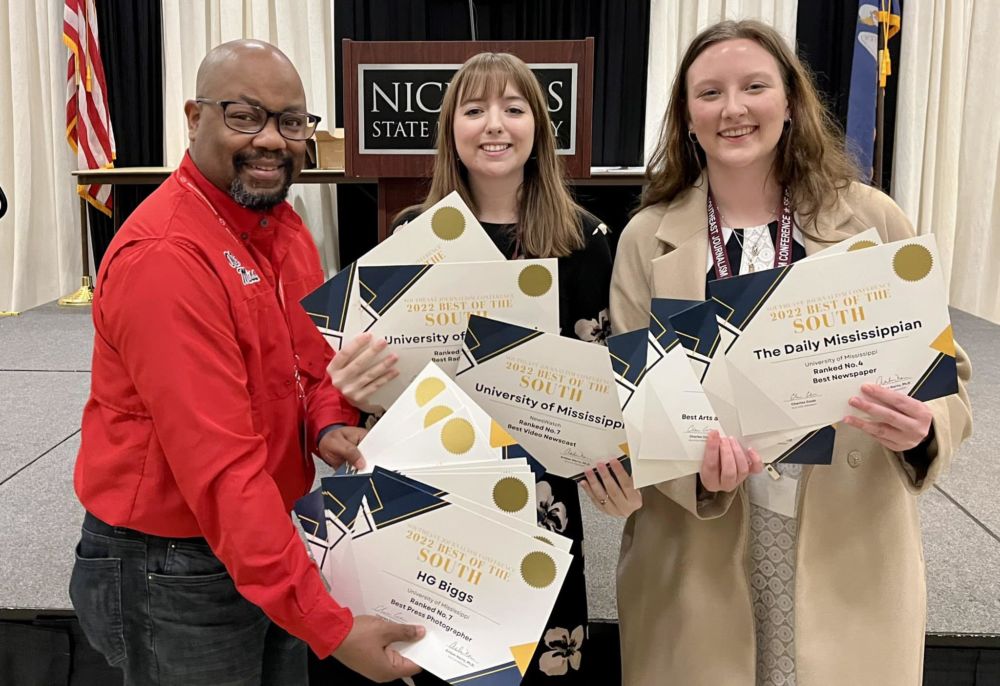
University of Mississippi students won more awards than any other college in the annual Best of the South contest, including four first places.

The students won a total of 11 Best of the South awards, and an additional five awards – including one first place for public relations – in the onsite competitions held at the conference, Feb. 21-23 at Union University in Jackson, Tenn.

Best of the South
Margaret Ann Morgan was named Best Multimedia Journalist, Bracey Harris was named Best Magazine Writer, Benjamin Hurston was named Best Magazine Layout Designer and Nick Andrews was named Best Radio Journalist. All four are Meek School students active at the Student Media Center.

The Daily Mississippian won fourth place in the Best College Newspaper category. Twenty-nine campus papers entered that category, and The DM was the top-ranked daily paper.
NewsWatch won third place for Best College Video News Program. TheDMonline.com won second place for Best College Website.

The contests are sponsored by the Southeast Journalism Conference, which has 45 member universities in eight states. This year, there were 430 entries in Best of the South, covering the contest year from mid-November 2011 through mid-November 2012.

Morgan’s Best of the South multimedia entry focused on coverage of Hurricane Isaac, and included an article in the DM written under daily deadline pressure, NewsWatch live reports, and an online photo/audio package. The judge wrote, “Very nicely done. The ability to produce video, still image, text and broadcast quality stand-ups means some news organization ought to hire this student quickly.”

The DM was required to enter publications from two dates for the Best College Newspaper category. The judge in that category praised the staff for “ambitious ideas, creative approaches to sports and strong photography.”

A broadcast judge wrote about the NewsWatch video program entry: “I felt like I got an accurate account of not only what’s happening on campus but across the state.”

Harris and Hurston won for their work in “The Flood of the Century,” a depth report about flood control on the Mississippi River. Judges praised their creativity and imagery.

Other Best of the South awards, all for work published in The DM: Josh Clark, second place for editorial cartoons; Kristen Saltzman, second place for advertising design; Austin Miller, third place for Best Sports Writer; Mary B. Sellers, fourth place for Best Arts & Entertainment Writer.

Onsite Competitions
In the PR: Crisis Communication category, the Ole Miss team of Frances Allison, Jane Lloyd Brown and Alyssa Randolph took first place.

Austin Miller won second place for copy editing. Emily Roland won third place for page design; Adam Ganucheau won third place for news writing; and Phillip McCausland won third place for editorial writing. All are DM editors and writers.

The onsite competitions included 11 categories. About 300 students from 24 colleges attended the SEJC conference, and many of them participated in the onsite contests.

A Question of Race at Ole Miss

Photo by Alex Edwards. Courtney Pearson and her father, Commander Kerry Pearson walk across the Ole Miss football field during halftime of the Ole Miss, Auburn football game. Pearson was became the university's first African-American homecoming queen in the school's history.


Courtney Pearson and her father, Commander Kerry Pearson, walk across the Ole Miss football field during halftime at the Ole Miss-Auburn football game. Pearson became the first African-American homecoming queen in the university’s history. Photo by Alex Edwards.

By Alex Edwards

Although 33 years separate their time at the University of Mississippi, Rose Flenorl and Courtney Pearson share many similar experiences growing up in the southern United States.

Their individual experiences at Ole Miss help illustrate the racial changes that have been made over the past 50 years at the state’s oldest university. The University of Mississippi was chartered in 1844 and welcomed its first class of 80 students in 1848. After 114 years, James Meredith’s enrollment forcibly ended Ole Miss’ segregation and created new opportunities for blacks in Mississippi. Read more at www.hottytoddy.com.

New website means new opportunities for Meek School students

HottyToddyLess than five months after launching HottyToddy.com, the locally-owned and operated website is getting thousands of daily hits and already partnering with Meek School classes for daily stories and special event coverage.

On National Signing Day, students in Prof. Cynthia Joyce’s Journalism Innovation class used Twitter to cover the day’s event and created a Storify presentation of the best social media content published around the topic.

In the advanced TV reporting class, a team of 11 broadcast journalists, supervised by Prof. Deb Wenger, took their cameras and their smartphones out to the Oxford Conference Center to cover the Ole Miss Quarterback Club event.  Students involved in the class had good things to say about the real-world experience.

“Knowing that the event was receiving national attention; it’s really cool covering something you know is going to also be covered by ESPN,” said Bracey Harris, a student in the class.

The result was thousands of hits to the website and hundreds more followers and fans on social media.

Now, HottyToddy.com invites students throughout the school to get involved in the all-digital news source, which is designed to connect the global family of those who love Ole Miss and Oxford.

According to HottyToddy.com founder’s Ed Meek, regardless of your media specialty, opportunities to build your skill levels and add to your portfolio of work are possible.

“You can be part of an exciting new digital environment which integrates social media with the Web,” Meek said. ‘This is a great way to get experience and prepare for the job market.”

The site is looking for social media interns, general assignment or feature reporters, photojournalists, graphic design interns and advertising sales interns. Students can register for academic credit by filling out the appropriate forms.

HottyToddy,com is advertiser-supported but all profits benefit the scholarship program at the Meek School of Journalism and New Media.

To learn more, contact Michael Harrelson at michael.harrelson@hottytoddy.com.

MPA judges reward DM’s advertising and special sections

Student MPA Handbook Cover

Advertising and editorial students and staff at The Daily Mississippian won three first place awards and a second in the Mississippi Press Association’s advertising division annual competition. The Daily Mississippian competes against professional newspapers throughout Mississippi in this contest, not other college newspapers.

Winning entries were:

• Grocery or Restaurant Advertisement – Black & White
The Library ad printed Oct. 11, 2012, promoting the USC-Cal game and Mustache the Band took first place in the Daily Division A & B – (above 9,000) circulation category.

Second and third place awards went to the Northeast Mississippi Daily Journal.

• Small Space Ad – Black & White
The Ole Miss Golf Course ad printed Jan. 25, 2012, promoting “one college course you don’t want to miss” took first place in the Daily Division A & B – (above 9,000) circulation category.

Nate Weathersby was the ad designer and judges commented, “Ad looked very professional and printed well.”

Second place went to the Northeast Mississippi Daily Journal and third place to The Natchez Democrat.

• Advertising Special Section – Newsprint
The Back to School section, issued Aug. 20, 2012, took First Place in the Daily Division B – (9,000-15,000) circulation category.

Ad designers were James Hall and Debra Novak, creative services manager.

Sales staffers for the section were LeAnna Young, Michael Barnett, Ryan Herget and Meghan Jackson.

The cover photo was by Alex Edwards, and the section was edited and designed by Emily Roland, Kristen Stephens and Cain Madden.

Second and third place went to The Natchez Democrat for a Black History section and a Fall Pilgrimage section.

• Niche Product
The Rebel Handbook, Orientation Guide Summer 2012, took second place in all dailies category.

Ad designers were Kristen Saltzman, Nate Weathersby and Debra Novak.

The sales staff was George Bordelon, Ryan Herget and LeAnna Young.

The cover photo was by Alex Edwards and the cover and editorial pages were edited and designed by Emily Roland and Kristen Stephens.

First place went to The Natchez Democrat for Profile 2012 Generation Us and third place went to The Commercial Dispatch (Columbus) for a Dining Guide.

The MPA presented the awards at the organization’s Mid-Winter Conference in Jackson. The S. Gale Denley Student Media Center at Ole Miss is directed by Patricia Thompson. Several Meek School journalism faculty spend time advising students at the SMC each week. In addition to The Daily Mississippian, students from all academic disciplines work at the center to provide content for websites and apps, produce a 30-minute daily newscast, create the university yearbook and staff a 5,000-watt FM radio broadcast.